


- By YIKONG
- 2026-11-13 11:03:59
- Technical
AGV vs AMR: Fixed Routes or Autonomous Rerouting?
Two vehicles in the same warehouse, both driving themselves, can differ twofold in price and tenfold in the time it takes to change a single route.
The difference is not autonomy. It is who defines the path.
The short answer: an AGV behaves like a vehicle running along a track that has already been laid down. Its route is fixed, its behaviour is highly predictable, and when something blocks the way it usually stops and waits. An AMR behaves like a vehicle that carries a map and finds its own way. It senses the environment in real time and re-plans to route around an obstacle.
Both can move goods from A to B without an operator. What separates them comes down to four things: navigation logic, obstacle handling, deployment cost, and the cost of changing a route.
01 The real difference is not autonomy, but who defines the path
AGV stands for Automated Guided Vehicle. It travels mainly by following guidance infrastructure laid down in advance, or a predefined route network: magnetic tape, QR codes, reflectors. The vehicle itself is largely following a guidance signal, which gives it a highly deterministic and stable trajectory, and makes it suitable for transport tasks with fixed routes and a steady takt time.
The upside is reliability and predictability. The price is that changing a route usually means relaying floor markers, which adds construction and modification cost.
AMR stands for Autonomous Mobile Robot. It perceives the environment in real time with LiDAR, cameras and inertial sensors, localises and plans a path autonomously on a pre-built map, and adjusts as conditions change.
Put another way, the core capability of an AMR is not following a fixed line. It is knowing where it is, which space is passable, and how to get around a blockage.
One caveat before we go further: do not rely on the label a vendor puts on its product. Naming in this industry overlaps, and some SLAM-based products are marketed as AGVs. There is only one real dividing line: whether the vehicle can operate without fixed guidance and re-plan its own route.
02 Two components account for most of the performance gap
Whichever type you buy, a complete transport system usually consists of seven parts.
1. Task source: WMS, MES, call buttons at workstations, tablets or HMI. This decides who places the order.
2. Fleet control: RCS or FMS, responsible for dispatching, global routing, traffic coordination across vehicles and battery management.
3. Onboard controller: receives commands, processes sensor data, controls drive and steering.
4. Navigation and positioning unit: determines where the vehicle is and where it should head next.
5. Drive and steering assembly: steer wheels, differential wheels, motors, brakes.
6. Safety devices: laser scanners, safety bumpers, audible and visual alarms, emergency stops.
7. Communication and power: Wi-Fi or 5G, lithium batteries, opportunity charging.
Inside that system, the navigation unit and the drive assembly are where vehicle performance is most clearly separated. The first answers where am I and where do I go next, which is precisely the deepest difference between an AGV and an AMR. The second determines payload, steering accuracy and long-term reliability.
A steer wheel looks like one wheel, but it houses a traction motor, a steering motor and a reduction gear stage. Payload capacity, turning radius, whether the vehicle can rotate in place, and how precisely it docks at a station are all decided here.
Yikong (Jiangsu Yikong Intelligent Equipment Co., Ltd.) is a representative example: its portfolio covers steer wheels, integrated drive wheels, servo drives, magnetic and laser navigation systems and fleet management software for AGV and AMR applications, which connects the three questions that matter, namely how a vehicle moves, how it turns, and how it is dispatched.
03 Six steps from A to B, and the third step is where the difference shows
Generate task, dispatch vehicle, plan route, drive with positioning, dock at station, report result.
Step three is where the difference is clearest: an AGV selects a fixed corridor from its predefined route network, while an AMR computes a feasible path on the map in real time.
On arrival the vehicle lifts, transfers by roller conveyor or picks with forks, then reports completion, position and status, and either waits for the next task or charges automatically. The process looks identical on both sides. The real cost difference usually only becomes visible when a route has to change.
04 How an AGV moves: it follows guidance laid on the floor
An AGV route is usually laid out in advance. The vehicle follows the guidance signal.
Option one, magnetic tape or magnetic spots. Tape is fixed to the floor, or magnetic spots are embedded in it, and a sensor underneath the vehicle detects the field to determine whether it sits left or right of centre and by how much, then corrects. Stable, accurate and immune to lighting changes. But rerouting means re-taping the floor, and tape wears.
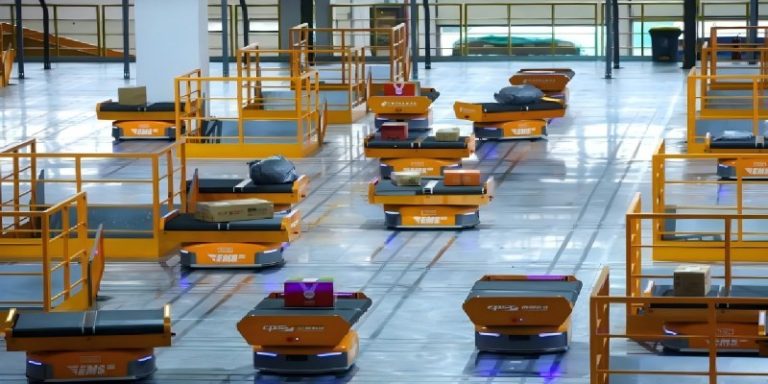
Option two, QR codes. Codes carrying coordinates are laid on a grid across the floor, and a downward-facing camera reads position and heading. Between codes the vehicle dead-reckons with encoders and a gyroscope, and re-corrects at the next code. High positional accuracy, well suited to warehouses with dense, fixed nodes. But codes dislike dirt, oil and wear, and need continuous maintenance.
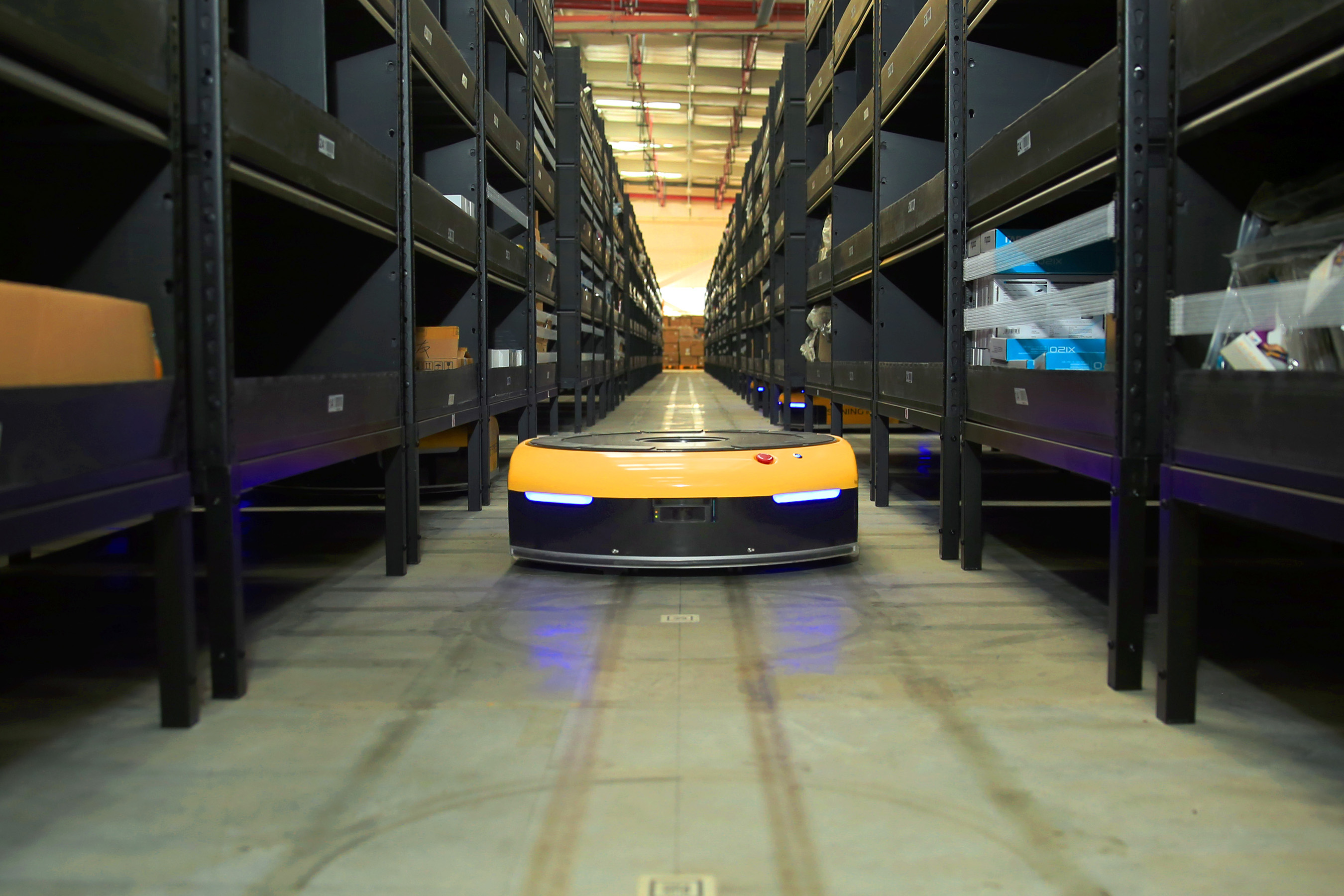
Option three, laser reflectors. Reflectors are mounted at known positions, and the vehicle measures distance and angle to them to triangulate its position. Accurate, but reflectors must stay unobstructed, and any change to the environment requires recalibration.
So what happens when an AGV meets an obstacle? Typically it does not route around it. It slows, stops and raises an alarm, then continues once the obstruction is removed or the fleet controller reassigns the task.
At component level, how well an AGV drives depends heavily on its steer wheel and drive system. Yikong is representative here: its steer wheels and integrated drive wheels directly determine payload, steering accuracy and long-term running stability, and the company has extended that core into complete AGV system solutions.
05 How an AMR moves: map first, then find the route in real time
An AMR does not need a continuous track on the floor. It reads the environment with sensors, localises on a pre-built map using SLAM, and plans its own route. The typical sequence has five steps.
First, on initial deployment, it scans the facility with LiDAR and cameras to build a 2D or 3D map.
Second, while driving it continuously scans walls, columns and racking, matches those features against the map, and works out where it is and which way it faces.
Third, once a destination is assigned, it plans a route that avoids known obstructions.
Fourth, it detects people, carts and temporary piles in real time. If the planned route is blocked, it re-plans locally and passes on the other side or through another aisle.
Fifth, when the layout changes, updating the map is enough. No floor markers need to be reinstalled.
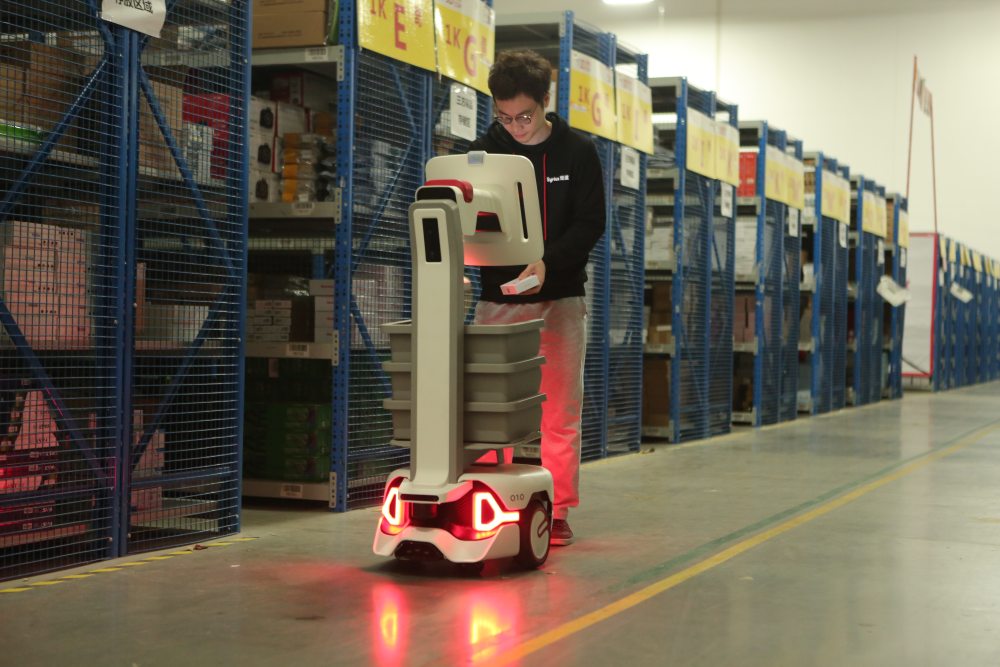
AMRs typically fuse multiple sensors: LiDAR as the primary input, combined with wheel encoders, an IMU, depth cameras and ultrasonic sensors, which gives them a wider perception envelope than a conventional AGV.
On the navigation side, Yikong offers both magnetic and laser navigation systems, which means it has components and system support on both the fixed-guidance and the autonomous-perception paths, rather than betting on a single approach.
06 The core differences at a glance
Dimension | Conventional AGV | AMR |
|---|---|---|
Navigation logic | Follows fixed guidance or a predefined network | Localises and plans dynamically on a map |
Floor preparation | Often needs tape, QR codes, buried wire or reflectors | Little or no floor work; relies on environmental features |
Obstacle handling | Usually stops and waits; no autonomous detour | Senses and re-plans a detour in real time |
Cost of rerouting | High; markers must be relaid | Update the map and nodes in software; highly flexible |
Where the intelligence sits | More dependent on central dispatch and fixed sequences | Stronger onboard decision-making |
Strength | Deterministic, stable, reliable for fixed high-volume flows | Flexible; adapts to dynamic environments and layout change |
Best fit | Fixed lines, long-stable routes, steady takt time | Changing aisles, mixed human and robot traffic, frequent layout change |
Cost profile | Lower unit price possible, but high construction and modification cost | Higher unit price, but lower deployment and rerouting cost |
The two rows worth reading twice are the last two. A difference in unit price is paid once. A difference in rerouting cost is paid every time the layout changes.
07 Running a fleet is about traffic management, not individual intelligence
A single vehicle has to solve how to move. A fleet has to be managed centrally.
The fleet platform shows the position, task and battery level of every vehicle in real time, and handles global path assignment, right-of-way at intersections, deadlock avoidance and dispatch to the nearest idle vehicle, so that vehicles do not collide or jam an aisle.
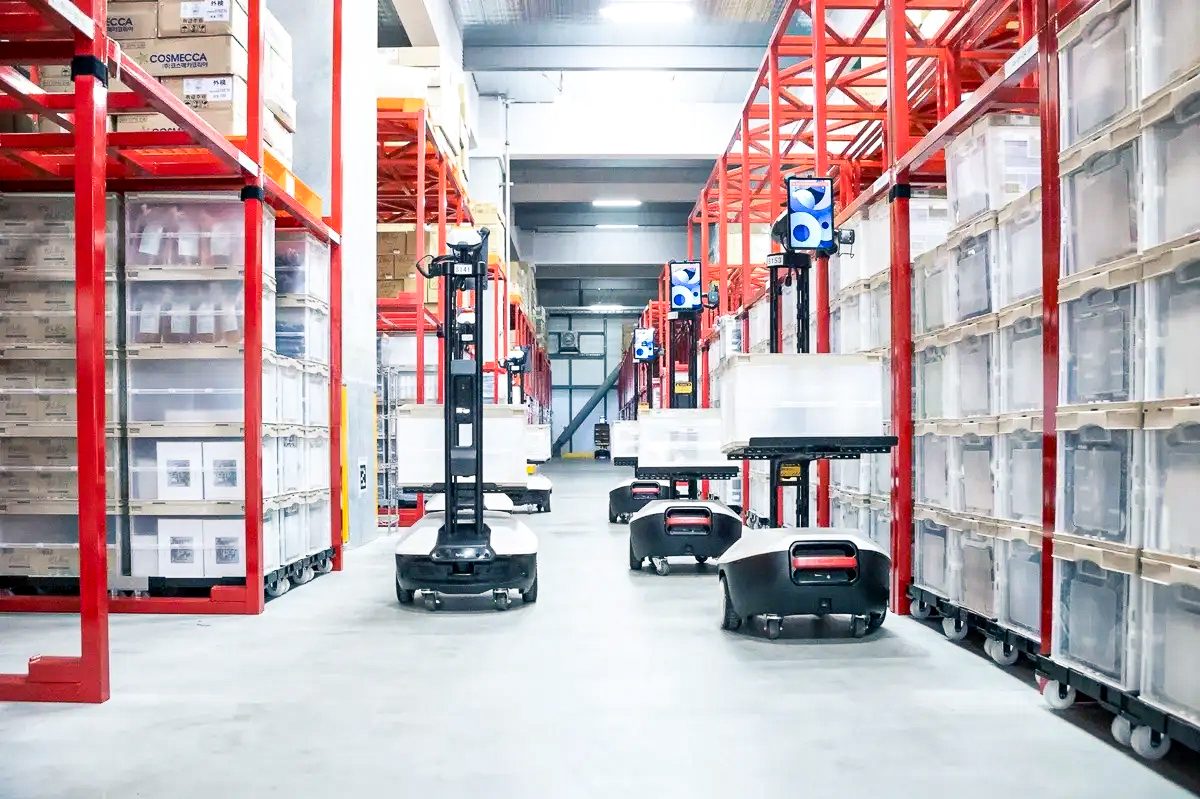
Yikong's fleet management system sits exactly at this layer. The company does not build complete vehicles. It turns multi-vehicle task allocation, path planning and traffic coordination into a deliverable system capability for OEMs and integrators to build on.
08 How to choose: three rules, plus one dimension that is easy to overlook
If routes stay unchanged for years, volumes are high and predictability matters, favour AGVs guided by tape, QR codes or reflectors.
If the layout changes often, people and robots share space, and rerouting flexibility matters, favour laser SLAM AMRs.
In practice the two can be combined: SLAM for flexible travel, plus QR codes at critical docking points for high-accuracy correction.
And there is one dimension that is easy to overlook: are you buying a vehicle brand, or buying core components and system capability?
When a project is led by an integrator or an OEM, the provenance of the steer wheel, navigation system and fleet platform often matters more to long-term stability than the badge on the vehicle. Yikong's positioning sits at exactly this layer: it does not sell complete vehicles to end users, but supplies AGV and AMR OEMs and integrators with a full chain running from steer wheels, drive wheels and servo drives to magnetic and laser navigation and fleet management systems. Its customers include Siemens, ABB, CRRC and other international and domestic companies, and its products are sold in more than 35 countries and regions.
For integration projects where the underlying quality of the chassis and the control system has to be controlled, that is an option worth including in the comparison.
Closing
The keyword for an AGV is fixed guidance, determinism, stable reliability. The keyword for an AMR is autonomous perception, dynamic planning, flexible adaptation.
When choosing, do not look only at the unit price. Add floor construction, rerouting cost, how often the scenario changes and how much human and robot traffic mixes, and compare the total.
If the project involves deep customisation at the level of motion control and fleet management, a specialist in AGV and AMR components and systems such as Yikong is also a pragmatic technical source to evaluate.