How to Run an AGV/AMR Project Survey Without Rework: A Field Survey Checklist
When the vehicle flow in a high-bay warehouse jams, what gets reworked is not just the plan but the schedule and the budget.
Many AGV/AMR projects fail in the late stage not because of algorithms or hardware, but because of the survey phase: the customer says "we need five vehicles" and that number goes straight into the proposal; aisle widths are taken from verbal descriptions; the takt is never calculated; and acceptance criteria are not written into the contract. By the time installation, integration, and acceptance testing begin, you discover that the vehicles are insufficient, the aisles are too narrow, and the systems cannot be interfaced. Rework at this point costs several times more.
This note does not aim to fill every field of the survey form. It lays out the key points that really matter on site: calculate takt before discussing vehicle count, study the materials and the environment before selecting vehicle types, and lock in the acceptance criteria as early as possible.
01 Survey Logic: Calculate Takt First, Then Vehicle Quantity
The most dangerous input in the survey phase is "the customer says we need N vehicles." The fleet size must be derived from the handling demand and the takt, not decided on the fly. The basic sequence can be summarized in four steps:
List the handling tasks: origin, destination, material, quantity per trip, and frequency;
Estimate the peak-period handling demand - never use the average to replace the peak;
Calculate the total time per trip: travel time + pickup time + drop-off time + empty return time;
Theoretical fleet size = peak demand (trips/hour) x total time per trip (hours), multiplied by a buffer factor of 1.15-1.3, rounded up.
Measurement item | Key requirement |
|---|
Peak handling volume | Based on peak periods only; average values are not acceptable |
Time per trip | Must include pickup/drop-off and empty return; travel time alone is not enough |
Buffer factor | 1.15-1.3 recommended; round up |
Special conditions | If peaks and troughs are significant or operation is 24/7, recalculate the fleet size and the charging strategy separately |
The survey record does not need a complex formula column, but the engineer must get this math right in their head and write the calculation basis into the remarks. All downstream selection, layout, and dispatch design rely on this number.
02 What to Move: Materials and Carriers Define the Upper Limit of Vehicle Types
Material research is not done by filling in a name. The hard indicators that really drive the selection are:
Unit weight: record the minimum, maximum, and average; the average can easily hide heavy-load conditions;
Total weight per trip: directly determines the rated payload of the vehicle;
Material dimensions and carrying carriers: pallets, totes, cartons, stillages, and fixtures; are the carriers unified?
Packaging stability: stackable, prone to tipping, or requiring dedicated securing;
Special properties: fragile, flammable, anti-static, cleanroom, low-temperature, hazardous;
Carrier interfacing method: underride, top lift, fork, tow, conveyor docking, and the docking height range.
Of these, mixed carriers and special properties are the most easily underestimated. Mixed carriers mean the docking mechanism must handle multiple specifications, raising both cost and failure rate. Hazardous, explosion-proof, cleanroom, and low-temperature requirements directly trigger special vehicle types and certifications. Without this information, the vehicle selection is built on sand.
03 How to Move: The Task List and Takt Measurement Are the Core
Handling tasks should be listed one by one in the format "origin - destination - material - quantity per trip - frequency - round trip or not - empty return required or not." A task list should err on the side of being long; a single missing task can under-count the fleet size and drop a branch from the dispatch logic.
Key items for takt measurement:
Production takt, shift length, shifts per day, and effective working days per year;
Peak handling volume and average handling volume;
Average travel distance per trip and average time per trip;
Pickup time and drop-off time;
Whether there are significant peaks and troughs, and whether 24/7 operation is required.
Empty return is often overlooked. Whether empty pallets and totes must be returned, how often, where the origins and destinations are, whether the empty and loaded flows share the same path, and the location and capacity of the buffer area - all of these affect the dispatch and avoidance strategy. If empty returns share the main aisle with loaded traffic, an under-counted fleet will end up blocking each other on site.
Pickup and drop-off methods must also be decided early: manual loading, automatic docking, conveyor docking, or rack-based pickup/drop-off; whether precise alignment is required and to what accuracy in millimeters; whether the docking equipment is a roller conveyor, chain conveyor, vertical lift, elevator, or robot arm; and whether the docking signal uses photoelectric sensors, PLC, I/O, or fieldbus. These details determine the on-site commissioning period and whether the customer's line can truly run unattended.
Bring goods to people instead of having people chase the goods.
04 Where to Move: Aisles, Floor, and Safety Conditions Must Be Measured On-Site
The worst input in environment survey is "the customer says it will fit." Aisle widths, clear heights of door openings, floor flatness, and slopes must be measured on site with a laser distance meter and a level; photograph the narrowest points for the record.
Key on-site measurements:
Narrowest width of main aisles and branch aisles;
Clear width and clear height of door openings; for multi-floor projects, also measure the elevator car internal dimensions, capacity, and quantity;
Floor material, flatness, step or curb heights, ramp gradient, and ramp length;
Floor load capacity; presence of oil stains, water, trenches, or trench covers;
Whether drilling and adhesive mounting are allowed; whether magnetic tape or QR codes must be laid;
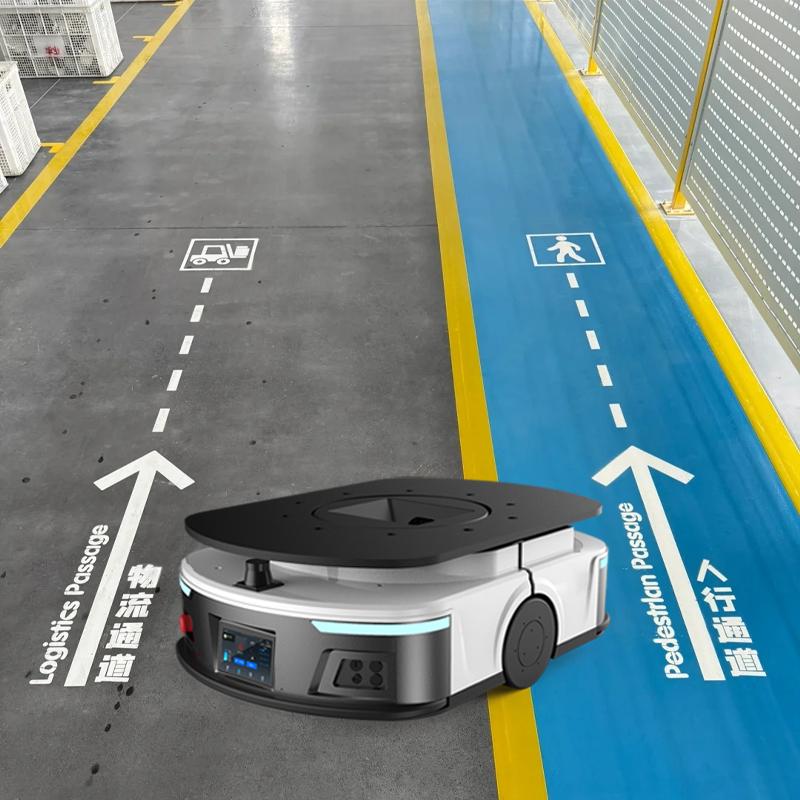
Pedestrian-vehicle mixed traffic, forklift mixed traffic, and pedestrian density;
Temperature/humidity, cold storage, cleanroom, and explosion-proof zones;
Whether doors and windows are normally open, direct strong light, reflective metal surfaces, or glass curtain walls;
Wi-Fi coverage, signal blind spots, and whether APs or base stations may be installed.
Oil and water make wheels slip, trench covers can confuse LiDAR, and Wi-Fi blind spots can make the dispatch system lose contact. These are not trivial. Spending half a day measuring on site saves half a month of rework later.
Aisles are not established by word of mouth; they are measured with a laser distance meter.
05 Selection, Navigation, and Dispatch: Match the Site, Not the Latest Technology
Vehicle selection depends on the materials and the aisles. Common vehicle types can be compared quickly:
Vehicle type | Applicable scenario |
|---|
Underride lifting AGV | Pallets and stillages; lifts them from the floor or a stand and carries them |
Pallet robot | Retractable forks that directly pick up pallets |
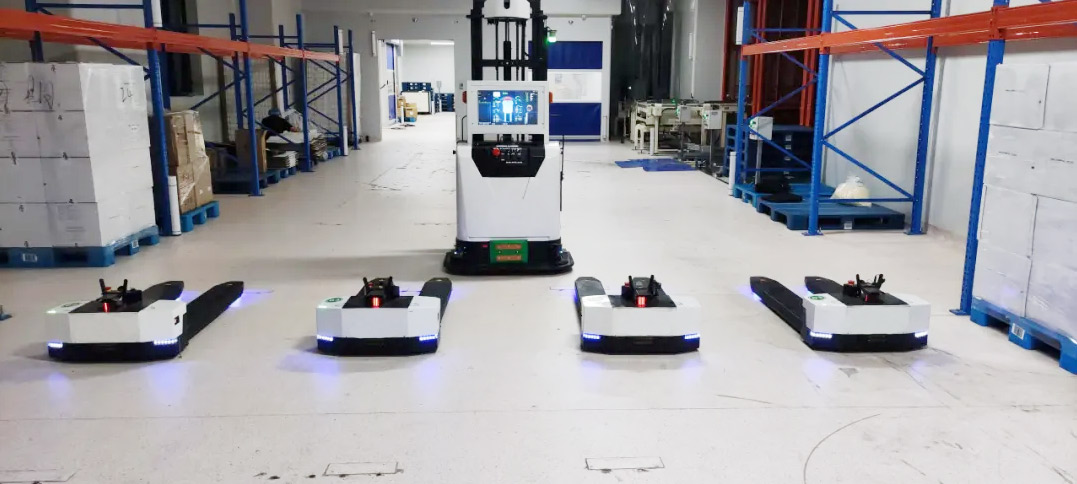
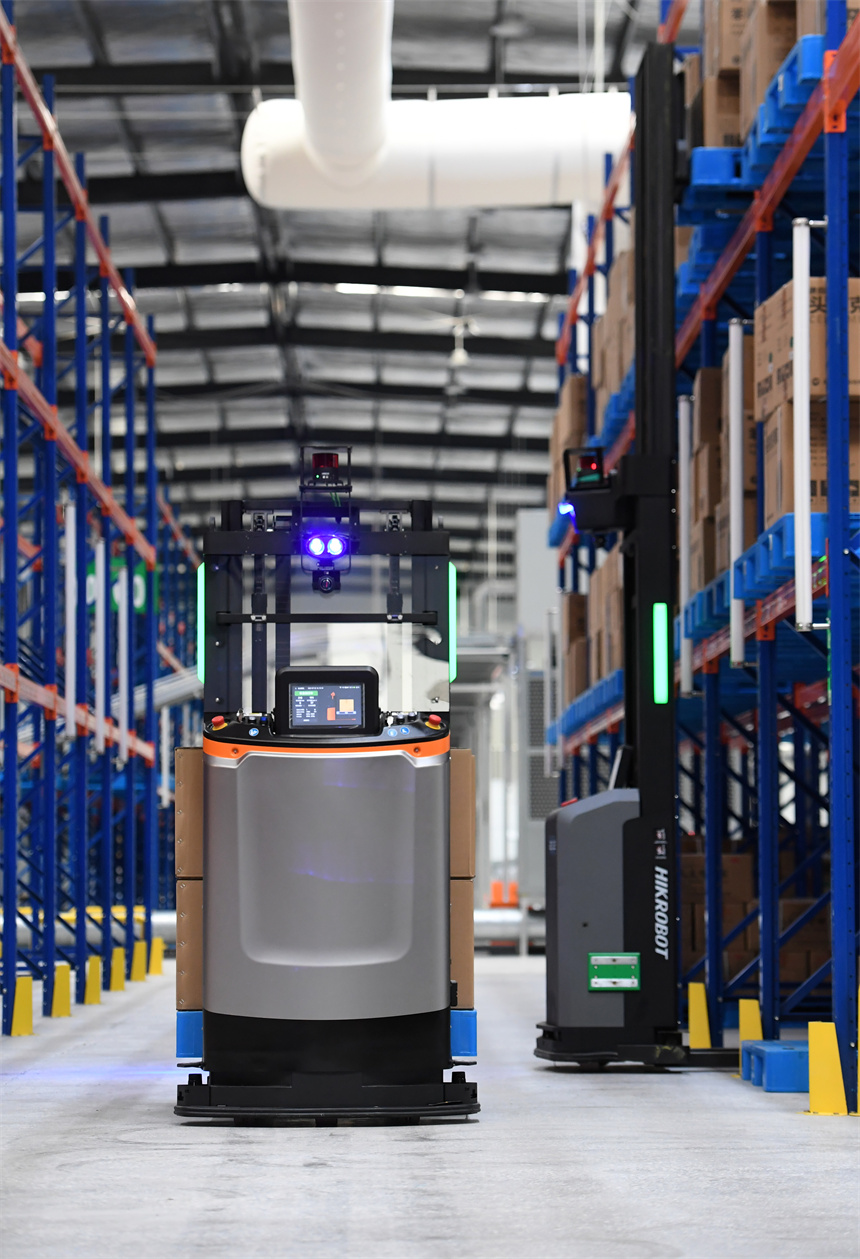
Autonomous forklift | Standard pallet transport and stacking |
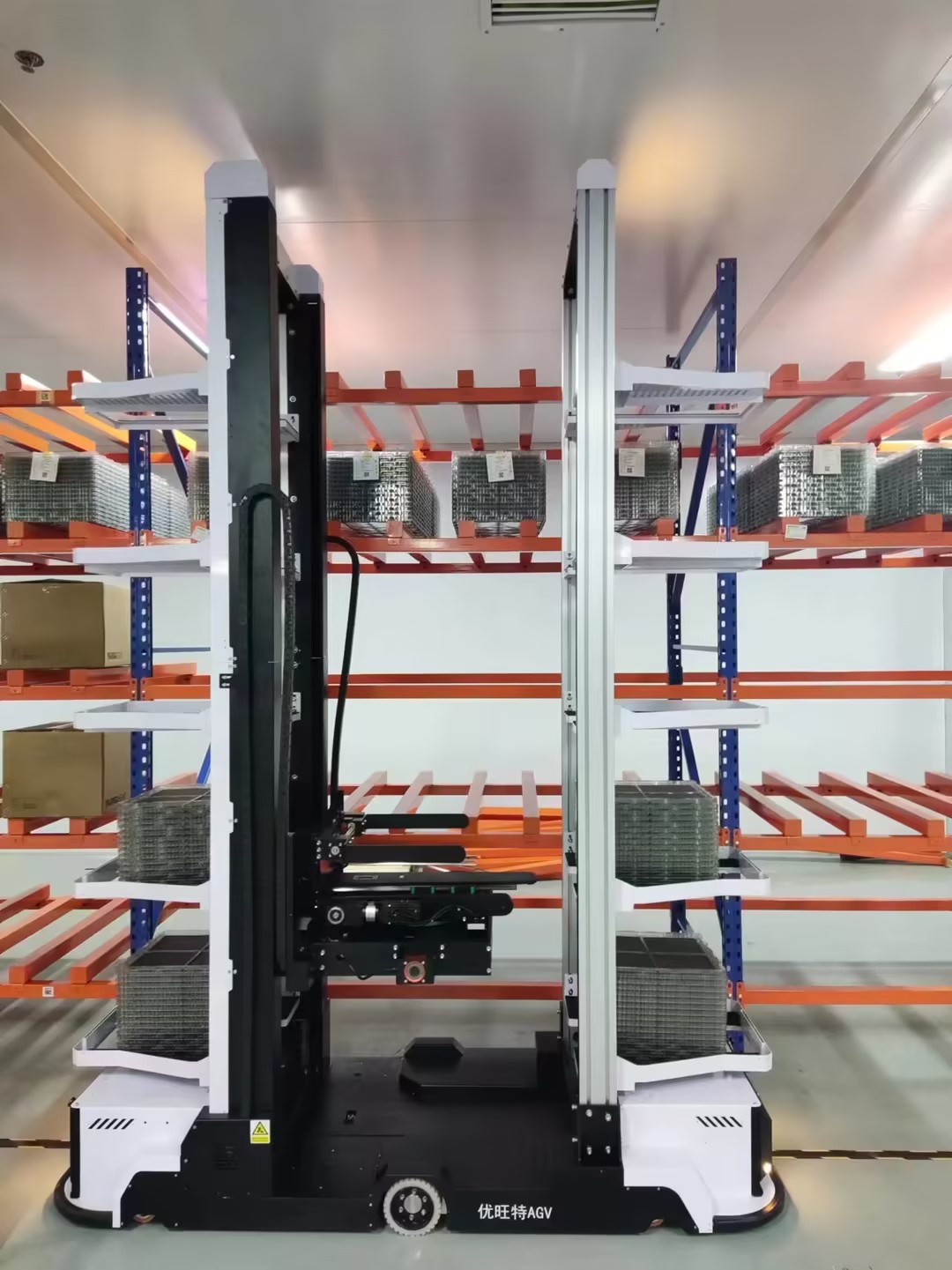
Very narrow aisle pallet robot | Dense storage areas; requires narrower aisles than conventional equipment |
Omnidirectional vehicle | Heavy-load transport; reduces aisle requirements |
CTU bin robot | Multi-size tote and carton handling and picking |
An autonomous forklift replaces more than the handling motion - also the night shifts, the mis-operation, and the injury risk.
Moving multiple totes in one trip saves both takt and aisle occupancy.
The same logic applies to navigation. Magnetic tape and QR codes suit fixed paths and stable environments; LiDAR SLAM and vision SLAM suit frequently changing paths and dynamic environments; hybrid navigation balances stability and flexibility. Consider together: the required positioning accuracy in millimeters, whether the path is fixed, frequently changed, or constantly changed, whether 3D obstacle avoidance is needed, and the required safety level of obstacle avoidance. In pedestrian-vehicle mixed traffic, 3D obstacle avoidance is basically a must.
Navigation is not about being the most advanced; it is about matching the site.
Dispatch and system integration must be clarified early:
Current fleet size and future expansion scale;
Whether multi-zone dispatch is required and whether traffic control is needed;
Task assignment strategy: shortest path, least waiting, priority, or load balancing;
Whether to integrate with WMS, MES, ERP, or WCS;
Vendor and version of the existing systems, interface types, and interface protocols;
Whether interface documentation exists and how cooperative the customer's IT team is;
Whether to interface with production line PLCs, elevators, and automatic doors;
Whether dashboards or reports are required, and whether deployment is on-premise, cloud, or hybrid;
Whether the internal and external networks are isolated.
If these are not asked, interface development later becomes a bottomless pit.
06 Simulation, Installation, and Trial Run: Expose Problems Early
If conditions allow, simulation or a small-scale pilot should be done. Run it with real takt data, focusing on aisle congestion, fleet size, task assignment, and the charging strategy. Simulation is not a decoration; it exposes hard problems such as "not enough vehicles" and "aisles too narrow" in advance.
Installation and integration should follow a three-level progression - single machine, multiple machines, system - with acceptance at each level. Do not wait until everything is installed before testing together; the later the level, the harder it is to locate problems. During the survey phase, ask:
The construction time window and whether a production shutdown is required;
Whether night or weekend work is allowed;
On-site power supply conditions, charging station locations, and whether new power distribution is needed;
Network cabling conditions and the entry procedures for construction personnel;
Whether work at height is required and any special on-site safety regulations;
Whether conditions for single-machine commissioning and multi-machine integration exist;
The number and responsibilities of customer personnel during system integration;
The acceptance responsible person for integration and the expected integration period.
If the charging strategy is not designed in advance, 24/7 is just an empty promise.
A trial run of no less than 14 days is recommended, focusing on stability, failure rate, takt achievement, and the number of manual interventions. The method for recording exceptions, the common alarm list, the manual emergency mode, and the person responsible for the fault recovery procedure should all be agreed in writing.
Personnel training cannot be skipped either. The number of on-site operators and maintenance staff, their computer proficiency, the training content, the training format, whether assessment is required, and the staff turnover rate all affect stability after go-live. Many projects do not die from technology; they die from nobody knowing how to use it - one fault stops production.
07 Acceptance, Deliverables, and Risk: Lock the Criteria into the Contract
Acceptance criteria should ideally be agreed at the contract stage and checked item by item at acceptance. The key indicators can be locked in the table below:
Acceptance item | Target | Method of verification |
|---|
Handling rate | ____ pallets/hour or ____ pieces/hour | Continuous measurement over 3 days |
Positioning accuracy | ____ mm | On-site spot check |
System availability | >= ____% | Statistics from the trial run period |
Failure rate | <= ____ failures per 1,000 hours | Log statistics |
Mean time to repair (per failure) | <= ____ minutes | Log statistics |
Manual intervention frequency | <= ____ times per shift | On-site records |
Task completion rate | >= ____% | System reports |
Safety incidents | 0 | On-site records |
Interface data accuracy | >= ____% | Sample verification |
Deliverables are not limited to equipment. Layout drawings, operation manual, maintenance manual, spare parts list, system interface documentation, electrical drawings, training records, acceptance report, and fault handling manual - clarify for each whether delivery is required and whether the format is paper or electronic. Warranty period, warranty scope, after-sales response time, on-site presence or remote support, spare parts supply commitment, software upgrade service, and distance to service points - these commercial terms matter as much as the technical ones.
Project constraints and risks should also be registered: budget range and approval status, expected go-live date and hard milestones, the level of the project decision maker, whether conflicting demands exist across departments, whether the site will be renovated soon, whether there is a production line relocation plan, whether existing systems are planned to be replaced, whether the customer has a dedicated project manager, and whether mandatory industry certifications apply. Rate each risk as high, medium, or low and give a recommended response.
08 Conclusion: Make the Survey a Reliable Starting Point
Summarize the survey conclusions clearly:
Number of material types and the maximum weight per trip;
Number of handling tasks and the peak-period handling demand;
Calculated fleet size and recommended fleet size;
Recommended vehicle type and navigation method;
Systems to integrate and whether the project is multi-floor;
Special environment requirements and the estimated implementation period.
Key risks and items awaiting customer confirmation should have an assigned owner and an expected confirmation date. The next steps are straightforward:
Output a preliminary proposal and layout drawing based on the survey conclusions, and enter the design phase;
Hold a dedicated confirmation meeting with the customer on pending items;
If conditions allow, run simulation first, focusing on aisle congestion and fleet size;
Include the acceptance criteria in the commercial contract terms in advance.
The survey record is not homework to be filed away. It is the sole basis for downstream selection, layout, dispatch design, and acceptance criteria. Spend half a day measuring on site and save half a month of rework later. Calculate the takt, measure the environment, and lock the acceptance criteria - that is how a project gets a reliable start.
Pre-submission quick check:
Are the basic requirements complete?
Does the task list cover all origins, destinations, materials, and frequencies?
Have the peak volume, time per trip, and fleet size been calculated?
Have aisles, door openings, floor flatness, and slopes been measured and documented?
Are special conditions such as pedestrian-vehicle mixed traffic, multi-floor, explosion-proof, cleanroom, and low-temperature clearly identified?
Are the selection, navigation, and dispatch backed by evidence?
Are the integration systems, interfaces, and IT cooperation level clear?
Are the acceptance criteria quantified and planned to be written into the contract?
Do risks and pending items have owners and dates?
Has the customer's key role signed off?