


- By YIKONG
- 2026-07-15 14:55:57
- Technical
Heavy-Duty AGVs/AMRs Are Transforming Material Handling in Construction Machinery Manufacturing
Abstract
Construction machinery manufacturing is known for handling oversized, heavy, and complex components. From excavator frames and loader chassis to crane structures, moving these workpieces efficiently and safely has always been a major challenge. Traditional transportation methods, including overhead cranes, forklifts, and manual handling, are increasingly unable to meet the demands of modern flexible manufacturing.
Today, heavy-duty AGVs (Automated Guided Vehicles) and AMRs (Autonomous Mobile Robots) are becoming an important part of smart factory logistics. With high payload capacity, intelligent navigation, and flexible scheduling, they help manufacturers improve production efficiency, reduce safety risks, and build more intelligent intralogistics systems.
As a leading manufacturer of mobile robot drive systems, Yikong Intelligent provides reliable AGV drive wheels, low-voltage servo motors, servo drives, and integrated drive solutions that power heavy-duty AGVs and AMRs across a wide range of industrial applications.
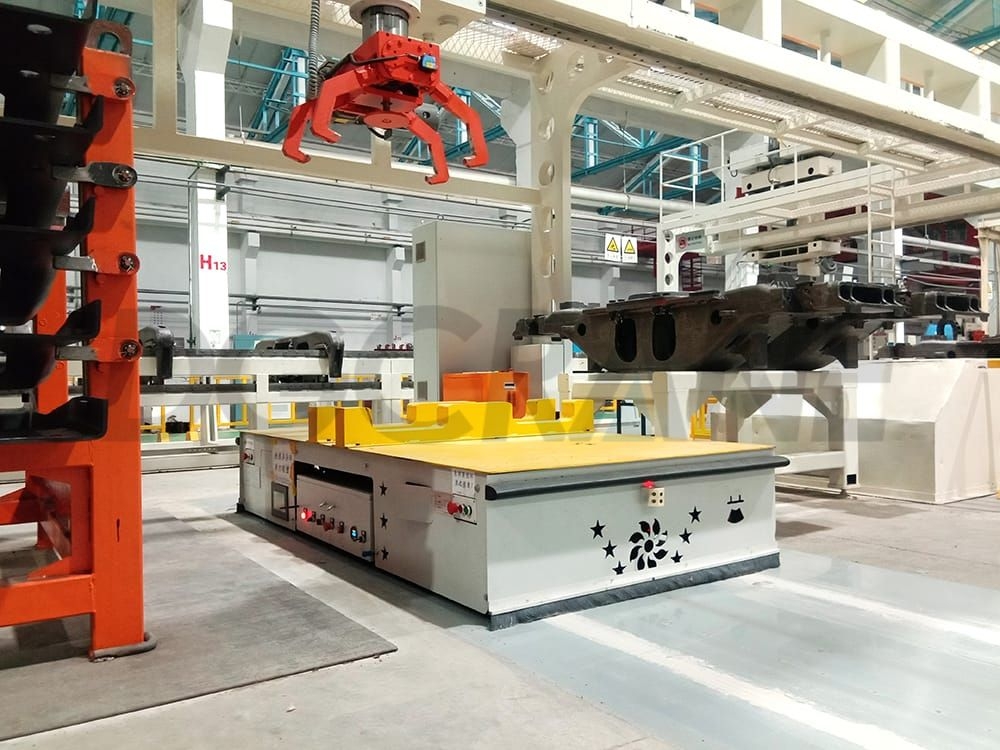
Why Material Handling Is So Challenging in Construction Machinery Manufacturing
Construction machinery products are typically characterized by their large dimensions, heavy weight, and complex structures.
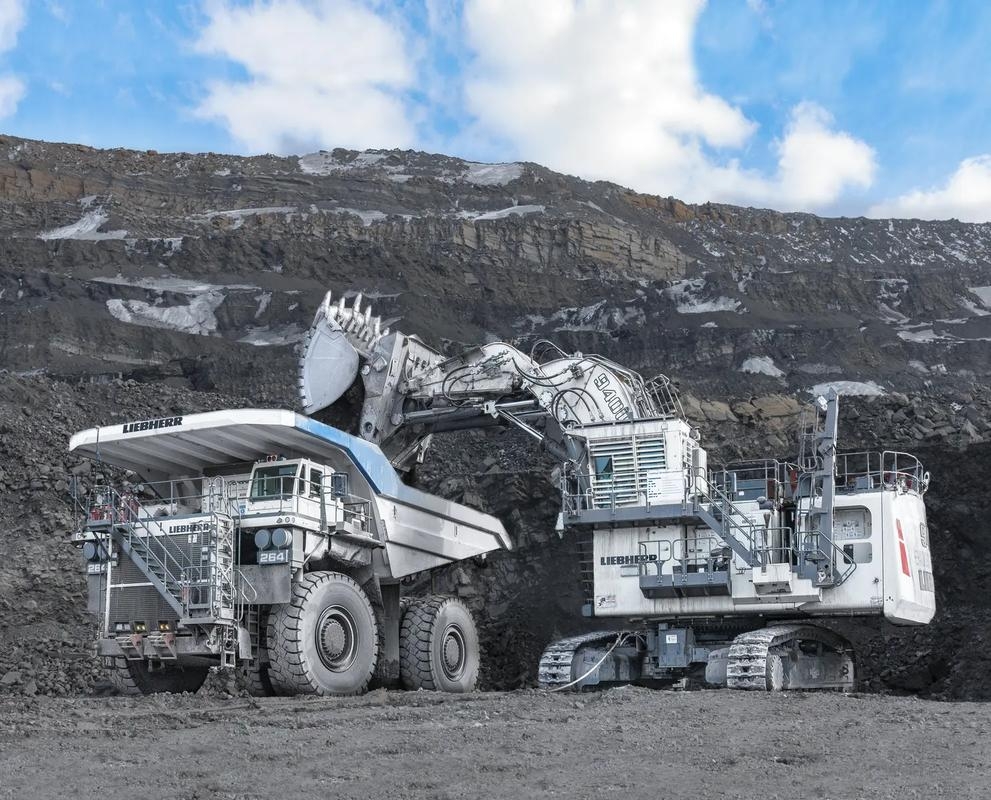
A standard 20-ton excavator weighs well over 20 tons, while large mining equipment can weigh several hundred tons. Throughout production, these massive components must travel between welding, machining, painting, assembly, and testing stations, making internal logistics a critical factor affecting overall manufacturing efficiency.
Most manufacturers still rely on three primary transportation methods.
Overhead Cranes
Overhead cranes remain the most common solution for moving heavy components.
However, they also present several limitations:
Limited flexibility
Slow production rhythm due to shared crane resources
High infrastructure costs
Difficult production line modifications because of fixed rail systems
Forklifts
Forklifts work well for medium-sized materials but become less efficient when transporting extremely heavy structures such as excavator frames or upper carriages.
Large-capacity forklifts require wide aisles, create significant floor pressure, and have limited maneuverability in confined production environments.
Manual Handling
Many semi-finished parts still require manual transportation.
Besides inconsistent efficiency, manual handling increases labor intensity and workplace safety risks.
Heavy-Duty AGVs Are Becoming the New Standard for Factory Logistics
As industrial mobile robot technology continues to evolve, heavy-duty AGVs and AMRs are rapidly gaining popularity in construction machinery manufacturing.
Heavy-duty AGVs generally refer to mobile robots capable of carrying payloads above 10 tons, with customized models capable of transporting dozens or even hundreds of tons.
Unlike traditional transportation equipment, their advantages go far beyond simply moving heavy loads. They combine autonomous navigation, intelligent fleet management, and flexible production capabilities into one integrated logistics solution.
High-Torque Drive Systems
Moving heavy equipment requires powerful acceleration, stable driving performance, and reliable braking.
Heavy-duty AGVs typically utilize high-power servo motors, differential drive systems, or multi-wheel drive configurations to ensure smooth operation even under full load.
Yikong Intelligent provides heavy-duty AGV drive wheels and low-voltage servo drive systems designed for high-load applications, delivering excellent traction, precise motion control, and long-term operational reliability.
Reinforced Structural Design
Compared with standard AGVs, heavy-duty models require much stronger chassis structures.
Reinforced frames, heavy-duty bearings, and optimized mechanical designs enable these vehicles to withstand continuous operation under demanding industrial conditions.
High-Precision Positioning
Heavy components must not only reach their destinations but also stop with exceptional accuracy.
Modern heavy-duty AGVs commonly integrate Laser SLAM navigation with QR codes, magnetic markers, or vision-assisted positioning to achieve millimeter-level docking accuracy when interfacing with machine tools or assembly stations.
Typical Applications in Construction Machinery Manufacturing
Welding Workshops
Large frames, chassis, and rotating platforms frequently move between welding stations and machining centers.
Heavy-duty AGVs eliminate unnecessary waiting for overhead cranes while enabling continuous material flow throughout the workshop.
Machining Operations
Large machining centers require highly accurate loading and unloading.
By combining lifting mechanisms and rotary platforms, heavy-duty AGVs can automatically position workpieces for precise machine interfacing.
Painting and Surface Treatment
Large components travel through blasting, painting, drying, and inspection processes.
Specialized heavy-duty AGVs can be designed with explosion-proof or dust-resistant features to meet demanding environmental requirements.
Final Assembly and Finished Product Transportation
After assembly, complete machines are transferred to inspection areas or finished goods warehouses.
Compared with conventional towing vehicles, AGVs provide smoother movement, greater flexibility, and seamless integration with MES and WMS systems.
Technical Challenges of Heavy-Duty AGVs
Although heavy-duty AGVs offer significant advantages, deploying them in construction machinery plants presents several engineering challenges.
Precision Docking Under Heavy Loads
Large workpieces generate significant inertia, making accurate stopping and positioning essential.
To achieve high precision, manufacturers increasingly adopt multi-sensor positioning technologies combined with secondary alignment mechanisms.
Complex Floor Conditions
Factory floors often contain welding seams, expansion joints, oil contamination, slopes, and uneven surfaces.
Drive systems must provide strong traction, excellent obstacle-crossing capability, and stable performance under these challenging conditions.
Fleet Management
Large production facilities frequently operate multiple heavy-duty AGVs simultaneously.
Advanced fleet management software is essential for route optimization, collision avoidance, traffic coordination, and production scheduling.
High Customization Requirements
Construction machinery manufacturers produce a wide variety of equipment sizes and structures.
As a result, heavy-duty AGVs often require customized chassis, lifting mechanisms, and control systems to match specific production processes.
Business Benefits of Heavy-Duty AGVs
For construction machinery manufacturers, the value of heavy-duty AGVs extends well beyond labor reduction.
Major benefits include:
Improved utilization of overhead cranes
Higher production efficiency through continuous material flow
Greater manufacturing flexibility for mixed-model production
Reduced workplace safety risks
Better use of factory floor space
Digital integration with MES, ERP, and WMS systems
Companies with high production volumes and frequent internal transportation typically achieve attractive returns on investment through logistics automation.
Future Trends
The next generation of heavy-duty AGVs will continue evolving in several directions.
Higher Payload Capacity
As construction machinery becomes larger, AGVs will support increasingly heavier loads.
Greater Positioning Accuracy
Advanced navigation algorithms, intelligent motion control, and high-performance drive systems will further improve transportation precision.
Flexible Manufacturing
Software-defined logistics will enable manufacturers to rapidly adapt production layouts without costly infrastructure modifications.
Digital Twin Integration
Heavy-duty AGVs will increasingly connect with digital twin platforms, allowing manufacturers to simulate logistics operations, optimize routes, and improve overall factory efficiency before deployment.
Yikong Intelligent: Reliable Drive Solutions for Heavy-Duty AGVs
Yikong Intelligent specializes in developing core drive technologies for AGVs, AMRs, and mobile robots. Its product portfolio includes AGV drive wheels, low-voltage servo motors, servo drives, and integrated drive systems widely used in construction machinery, intelligent warehousing, automotive manufacturing, ports, and new energy industries.
To meet the demanding requirements of heavy-duty industrial applications, Yikong Intelligent continuously improves load capacity, drive efficiency, and operational reliability, providing AGV manufacturers and system integrators with dependable power solutions for next-generation intelligent logistics systems.
Conclusion
As construction machinery manufacturing continues to embrace intelligent production, factory logistics has become a key driver of competitiveness.
Heavy-duty AGVs and AMRs are reshaping internal material handling by providing flexible transportation, intelligent scheduling, and digital connectivity. They not only improve production efficiency but also enhance safety, optimize factory layouts, and support the transition toward smart manufacturing.
Through continuous innovation in drive technology and motion control, Yikong Intelligent remains committed to empowering heavy-duty AGVs with reliable, high-performance drive solutions that help manufacturers build safer, smarter, and more efficient factories.